
Loading Section...
 Puri is not only a land
of temples, beaches
and secnic spots, but also a land of fairs and festivals. Every season in Puri brings
a host of colourful fairs and festivals
presenting joy to the visitors. Out of all, the most significant is the
Car Festival and it becomes most important
when associated with the Nabakalebara.
Puri is not only a land
of temples, beaches
and secnic spots, but also a land of fairs and festivals. Every season in Puri brings
a host of colourful fairs and festivals
presenting joy to the visitors. Out of all, the most significant is the
Car Festival and it becomes most important
when associated with the Nabakalebara.
What is Nabakalebara ritual?
Nabakalebara is a combination of two words Nava and Kalebara. In local Odia language, 'Nava' means 'New' and 'Kalebara' means 'Body', so the literal meaning of Nabakalebara is new body or re-embodiment. During the Nabakalebara ceremony the old figures of Lord Jagannath, Lord Balabhadra, Goddess Shubhadra and Lord Sudarshana are replaced by new onces. The figure of Lord Jagannath shelters a mysterious Brahma Padartha (The Supreme Matter) and is known as 'Daru Brahma'. During Nabakalebara this Daru Brahma (Prime-Soul enshrined in wood) is also transferred from the old figure to the new one.
When Nabakalebara ritual is celebrated?
The Nabakalebara ritual of the deities takes place in the year when the month of Asadha (June-July) happens to be an intercalary month (Double Asadha or two months of Asadha), which means when one lunar month of Asadha is followed by another lunar month of Asadha, known as 'Joda Asadha. Generally double Asadha come once in every 12 years but not strictly so. It may occur also in 8 years or 16 years or 19 years depending on the auspicious day.
The month of Joda Asadha (double Asadha) is composed of four fortnights, so the Anabasara or Anasara period of the Nabakalebara year extends over a period of one month and fifteen days (45 days). The extended Anasara period during Nabakalebara is known as 'Mahaanasara'. During this period, the temple remains closed for general public. During the first fortnight, the new deities are engraved on the Nirmana Mandapa. The second and third fortnights of the double Asadha months are known as 'Adhimasa' or 'Malamasa' or 'Purusottam Masa'. In the second fortnight (i.e. the first fortnight of Malamasa), the Dayitapatis observe the obsequies because of the death of their family Lords as they are the descendants of the Lords. In the third fortnight (i.e. the second fortnight of Malamasa) the wooden statues are covered with cotton and silken clothes and the Anabasara duties are performed.
What is the process of Nabakalebara ritual?
The process of Nabakalebara broadly comprises 12 steps.
Why Nabakalebara ritual is celebrated?
The tomes dealing with the principles of construction of images tell us about the lives of images built with jewel, metal, wood and clay. According to these tomes, images built with jewel have a life of ten thousand years, metal images have a life of one thousand years, wooden images have a life ranging between twelve and eighteen years and clay images have a life of only one year.
The Nabakalebar ritual is essentially unavoidable as an importance of the fact that the Deities of the Jagannath Temple are made of Neem (Margo) wood and wooden images are normally subject to decay in such a span of time, so changes of the Deities during such interval are felt essential.
History of Nabakalebara ritual
Nabakalebara is a very old ritual of the Jagannath Temple, but it's very difficult to guess the exact time since when it has been celebrated. As per researchers and historians, the exact starting year is not clear. The first Nabakalebara during British administration, according to the British records, was held in 1809. Madala Panji states that the first Nabakalebara was celebrated in the year 1817 during the British rule.
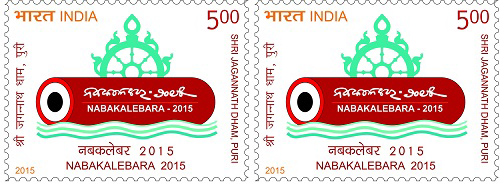
In the 20th century, the Nabakalevara festival was celebrated in Jagannath Temple in 1912, 1931, 1950, 1969, 1977 and 1996. The last Nabakalebara was celebrated in 2015 after a 19 year interval. The idols that are currently being worshipped in the Jagannath Temple were installed in the year 2015.
|
|||||||||||||||||||||||||||||||||||||||||||||||||||
When next Nabakalebar will be celebrated?
Next Nabakalebar festival will be celebrated in the month of Ashada (June/July) in 2034 after 19 years from the previous Nabakalebar.
Nabakelavara of Lord Jagannath is a most auspicious festival of Lord Jagannath Temple. The Bhagavad Gita tells us that every living being on this earth gradually attains youth, becomes old and finally dies. He is reborn in the world with a new body. The Nabakalebara of Sri Jagannath establishes this great truth. Lord Jagannath blessing the whole world and pass a message to human beings that nothing is permanent in the world. The Lord of the Universe teaches us that every creation in the world will destroy with time.
| Content Navigation | ||
| Next Page | ||
|
Loading Section...
Loading Section...
