THREE DEITIES OF JAGANNATH TEMPLE
Lord Jagannath is the presiding Deity of Puri Jagannath Temple. Inside the temple, He is worshipped with his older brother Lord Balabhadra, sister Subhadra and Lord Sudarshan. The three Deities (Lord Jagannath, Lord Balabhadra & Goddess Subhadra) of the Puri temple are generally known as the 'Trimurti' (Trinity). Including Lord Sudarshan, the four Deities are also known as 'Chaturdhamurti'. In local Odia language, 'Murti' means 'Idol'.
Lord Jagannath is the supreme Deity and the Lord of the Universe. The entire world, consisting of different communities, have been broadly classified based on their colours into three categories.
- Black for Negrito
- White for Aryan
- Yellow for Mongoloid
The three Deities of Jagannath Temple exhibits these three colours. Lord Jagannath is Black (inscrutability) in colour, Lord Balabhadra is White (enlightenment) in colour, sister Goddess Subhadra is Yellow (goodness) in colour. Such colour combination is unique in the whole pantheon of Gods and Goddesses worshipped in the entire world. This is a unique and convincing representation of the world community via the Holy Trinity of Jagannath Temple based on colour combination.
In the empirical language of physics, white a good reflector, yellow is one of the unadulterated primary colours and black is the most ideal absorber of radiation. Lord Balabhadra is the symbol of pure being or pure indeterminate sprit, has white colour, which is the synthesis and negation of all spectral. Goddess Subhadra is the symbol of Prakriti or Sakti, has yellow colour. Prakriti is the source of all living things and forms, which assumes various colours as they grow and develop, but at the origin are characterized by yellow colour. Black is no colour in itself, nor it is a synthesis of colours. It is the negation of all colours as well as the colourlessness.
The Deities of Jagannath temple at Puri are all made of wood taken from the "Neem Tree "(Melia Azadirachta Indica).The height of deities is between 2.5 to 3 meters. When touched, the deities give a soft feeling instead of hardness of wood. This is due to the layers of pure silk wrapped on the core wooden body. The eyes of Lord Jaganath are regular circles, and the eyes of Subhadra and Balabhadra are oval. The head top of Balabhadra is scalloped with a semicircular lobe indicating the hood of a serpent; Subhadra’s head top resembles a tiara and Jagannath’s head top simply a straight line. However, no one knows why these earless, legless, armless (only Goddess Subhadra) tribal forms of Deities with oversized heads attract people to keep the same traditions since many centuries.
Different meanings have been attributed to the three Deities, by various sects and schools of thought, have been classified below:
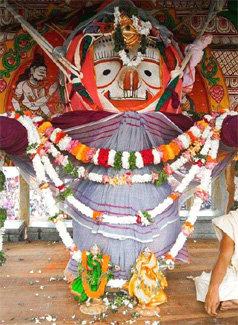
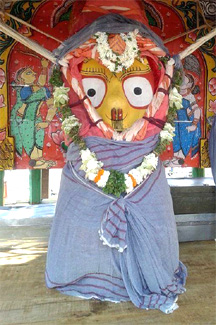
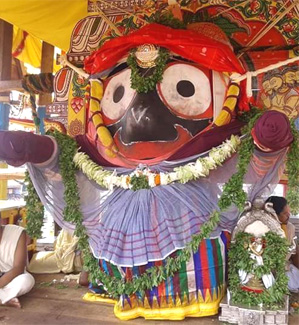
The three Deities have Vastra Shringara (dress regimen) too. Jagannath is dressed in clothes of prescribed colours viz. Sunday (red), Monday (white with black border), Tuesday (five assorted colours), wednesday (blue), Thursday (yellow), Friday (white), Saturday (black). As per lunar cycle deities are dressed up differently out of which 21 have historical significance viz. certain robes were introduced by none other than Chaitanya, Ganapatti Bhatta, Vallabhacharya, Ramanujaacharya and others in different centuries.
| Content Navigation | ||
| Last Page | ||
|
||
| Next Page | ||
|

