
Loading Section...
In the Vedas, Surya is conceived as an unified manifestation of the Brahmanical Trinity, the Morning Sun being identified with Brahma, the creator; the Mid Day Sun with Mahaswara, the destroyer and the Evening Sun with Vishnu, the presever. It is probably this conception that the artist had wanted to express in the three images of Surya, on the three sides of Konark Sun Temple.
Pravhata Surya - Morning Sun - The Creator
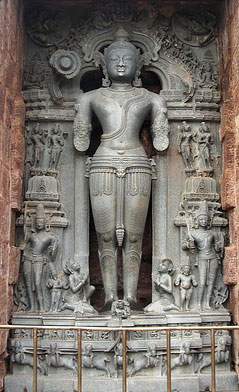
As the plan of the temple slightly makes an angle with the cardinal directions, the image of the south, is flooded with the rays of the morning-Sun and is therefore significant for its expression of youth and activity, justifying the description of pravhata-Surya (morning Sun). It is decorated with typical set of ornaments on the arms, neck and in the ears. The head-dress is also typical. The waist band is provided with tassels hanging down from it. This is called the avyanga (waist band) and is the Indianised form of Aiwiyonghen the secret waist girdle of the Iranians. The drapery, reaching upto the knee, is wonderfully carved. The hands of the statue holds two full bloomed lotuses, one of which still exists above the right hand of the figure. The bottom of the pedestal is decorated with figures of women in various poses. Some are playing on musical instrument and some are in dancing poses. It is also decorated with the figures of seven horses driven by Aruna, the charioteer of Surya, sitting near the feet of the statue with the reins of the horses in his hands. The King and the Queen are sitting on the pedestal with folded hands and the sword is lying nearby. In the panel two standing figures of male attendants are seen with shields and swords in their hands. His four wives-Rajani, Rikshubha, Chhaya and Suvarsasa are seen just above the two attendants. Bramha and Vishnu are sitting at a little higher level. At the topmost corners of the panel, Vidyadhars are seen offering garlands of flowers from the Heven.
Madhyanha Surya - Mid Day Sun - The Destroyer
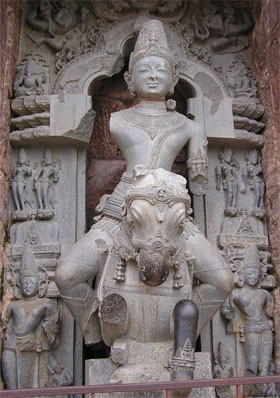
The figure in the western side may be taken as Madhyanha Surya (mid-day Sun), standing with full vigour and personality. Decoration of the panel, ornaments and drapery used, the presence of King and Queen, the seven horses and the figure of Aruna are almost similar to the prabhata-Surya (morning-Sun) who also wears upanat (boot). Some describe the Sun with Upanat-Pinaddha-Padayugalam (wearing boots in his both legs). It is stated in the Brihat Samhita, that the Sun God should be dressed in the fashion of a northerner, called Udichyavesa.
Astachala Surya - Evening Sun - The Presever
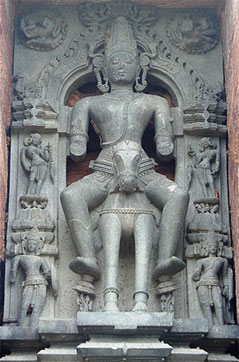
The third figure on the northern wall is the Astachala Surya (evening Sun or setting Sun) the figure brings out beautifully the tired expression which is the result of a hard days work, when all the other horses are completely tired, he is any how completing his journey by riding on the back of the last horse who is also found to be stooping with its folded legs.
| Content Navigation | ||
| Last Page | ||
|
||
| Next Page | ||
|
Loading Section...
Loading Section...

