
Loading Section...
Most of the architectural figures which made the temple so famous, were completely buried under the debris and sands, till the early 19th century. The existence of these beautiful lions, wheels, horses, elephants and the simhasana of Sun God being not known to the people, the visitors who came in these days could not even enjoy the halt of its beauty.
Narasimhadeva's desired temple was built in the form of a huge Ratha (chariot), having twelve pairs of wheels exquisitely carved out in the northern and southern sides of the plinth masonary and drawn by a team of seven spirited horses, speeding as if, through the heaven.
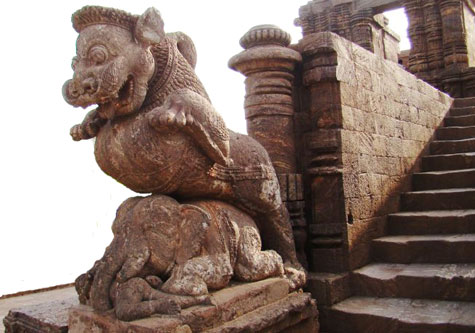
Royal guard of Konark - Lion upon elephant upon man
The eastern gateway which is the main entrance to the temple compound, is decorated with Gaja-Simha (Lion upon an elephant) images, with outward faces, installed on two high stone-benches on either side of the passage. Two high staone benches are also provided at the inner sides, possibly meant for the guards to sit.
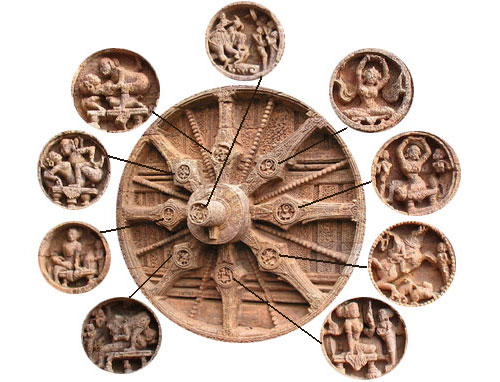
Great wheel of Konark
The wheels of the chariot are also symbolic and have been interpreted as the 'Wheel of Life'. They portray the cycle of creation, preservation and achievement of realisation. The diameter of each of the wheels is about nine(2.73 metres) feet and each of them has a set eight equal parts. They are elaborately carved all over. The thicker ones are all carved with circular medallions at their centres on the widest part of the face. The axels of the wheels project by about one foot from the surface, having similar decorations at their ends. The rims are carved with designs of foliages with various birds and animals, whereas the medallions in the spokes are carved with the figures of women in various luxurious poses, mostly of sensual nature. These wheels may also possibly represent the twelve Zodiacs.
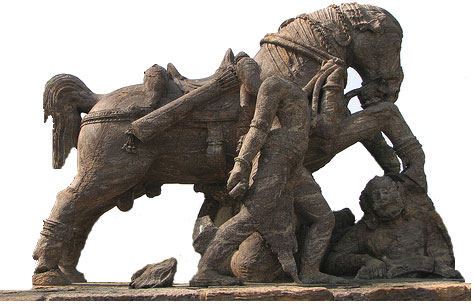
War horse of Konark temple
The seven horses, have been named in Bhagawat Gita, as 'Gyatri', 'Usnika', 'Anustuv', 'Vrihati', 'Pangti', 'Tristup' and 'Jagati' which possibly stand for the rhythmic representtion of the sacred verses of the Vedas.
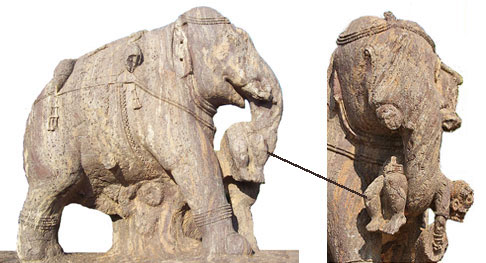
Elephants of Konark temple
The figures of elephants which had originally stood on the side walls of the flights of steps at the northern and southen sides of the Jagamohana, were found amidst the confused mass of debris. They are however, installed, in masonary platforms nearer to the compound walls, facing the main temple, but in fact, they are to face outwards, to welcome people coming in.
Simhasana (seat) of the presiding Deity
The simhasana (seat of the presiding deity) made of chlorite stone (a kind of volcanic rock) and beautifully carved all over, is still in existence within the sanctum. Its base and sides are decorated with beaded borders, enclosing rows of elephants and various scenes from day-to-day life, such as women carrying offerings, musical instruments and standing in groups with floded hands. The King and Queen are seen sitting in front. The floor of the room is also paved with chlorite slabs.
Although the presiding deity is now missing from the place, there is no doubt that the image of the Sun-God, actually occupied the Simhasana, rulling over the innumerable devotees who worshipped him for about four hundred years with all the pomp and glory, which traditionally accompanies the virtuals of worship. Otherwise the beautiful pedestal and the smaller one above it, would not have existed. A semicircular channel was also provided on the pedestal for easy flow of water from the body of the image.
| Content Navigation | ||
| Last Page | ||
|
||
| Next Page | ||
|
Loading Section...
Loading Section...

