
Loading Section...
The higher layer (above the basement and middle layers) of Konark Sun Temple contains a number of bigger sculptures, mostly sensual. In some carvings, the obscentity is to such a great extent that Vatsayana even did not mention about similar postures in his books. Not with standing the vulgarity presented in the sensual scenes, the sculptures reveal the though knowledge of human anatomy that the artists had. In one scene a man is lifting a woman with both his hands and the woman clings to his neck. In this case the sculptors have wonderfully shown the expansion and contraction of the muscles, as a result of his lifting the woman. It is a proof of their technical experiences of centuries.
The preponderance of the vivid sensual scenes scattered in profussion may offend our prudish and sophisticated minds. It is not certainly the faults of the artists if what was natural to them, appears vulgar to us now. The morals of the people undergo various mutations in different periods of history. Some people say that these sensual figures were carved out their for the purpose of saving the temple by diverting the electrical flow from the eyes of the people or may be just a test for him, as to whether he has really come here to see the deity.
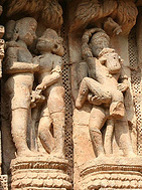
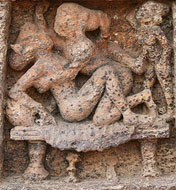
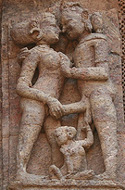
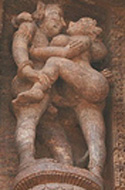
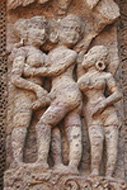
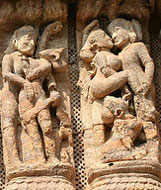
There is another altogether different interpretation of the matter. For the average man, the attainment of moksha (Success) can come after the fullfilment of all earthly desires, Dharma (religion), Artha (Wealth), Kama (desire) and not through repression. The figure of an ascetic in act of cotius seem to confirm the above interpretation. Whatever their object might be, love scenes in various poses, embracing hugging, kissing and in the act of cotious are indeed a feast to the visitors eye.
This was the age of Tantrism. Buddhism and Saivaism both were developing side by side to become popular in the society. During the period from 10th to 12th century A.D., Buddhism was followed by Saivaism and was gradually became instinct. Several Budhist temples were converted to Siva temple and even Ashokan Pillar was found to have been used as Siva-Linga, during the period. But in the middle of the 12th century, Ananta Varma Chudaganga Deva, the great ancester of Narasimhadeva I, changed his faith from Saivaism to Vaisnavism, probably being influenced by the sudden appearance of Ramanuja, who was then preaching Vaisnavism in Odisha.
While the Buddhism was preaching for renouncing everything for the purpose of achieving moksha (success), the Vaisnavism at that time were teaching people, that the achievement of success was possible, if he can fulfil all his desires even by staying among the members of his family. People can only think of this when he is almost disgusted with all sorts of enjoyments.
| Content Navigation | ||
| Last Page | ||
|
||
| Next Page | ||
|
Loading Section...
Loading Section...

