BAHUDA YATRA & LAXMI NARAYANA BHETA
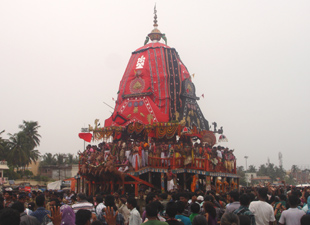
The word 'Bahuda' in Odia language means 'Return'. Bahuda Yatra is the Return Journey of the three chariots to Jagannath Temple. After spending a week inside the Gundicha temple, the deities commence their Bahuda Yatra on the 10th day. The return journey follows the same protocol and schedule, as is found during the Ratha Yatra. During the return journey, the three chariots stop for awhile at the Mausima Temple, also known as Ardhasani Temple. This temple is dedicated to the aunt of Lord Jagannath. Here three deities are offered 'Poda Pitha', a special sweet made of rice, coconut, lentils and jaggery.
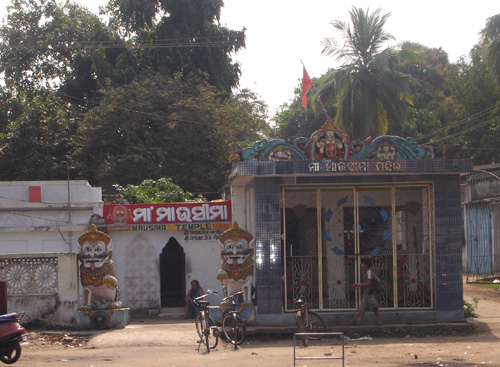
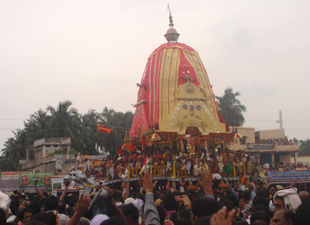
After taking Poda Pitha, three deities start their journey to the main temple. The chariots of Balabhadra and Subhadra move forward and are parked at Lion’s gate (Singha dwara) of the temple where as the chariot of Jagannath halts in front of the Gajapati King's palace for the divine event 'Laxmi Narayana Bheta'.
The Laxmi Narayana Bheta
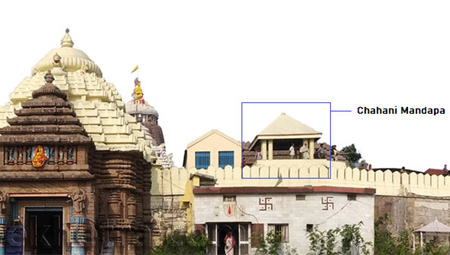
Lord Jagannath, the husband of Goddess Mahalaxmi did not took her to Gundicha temple during Car Festival, so on the Hera Panchami day, Mahalaxmi went to Gundhicha temple to meet Lord Jagannath but he closed the door of Gundicha temple and did not meet her. Due to these actions, Goddess Mahalaxmi was angry and her anguish still continues. She has asked her servitors to inform Her as soon as they come to know about his return. On Bahuda yatra day, when Nandighosa chariot reaches the King’s palace, Her servitors informed Her about Lord Jagannath's arrival, she is anxious to catch a glimpse of Her husband. Her servitors sense her mood and take Subarna Laxmi (representative idol of Goddess Mahalaxmi) in a gorgeously decorated palanquin to the 'Chahani Mandapa'. In local Odia language 'Chahani' means 'Glimpse' and 'Mandapa' means 'Podium'. Chahani Mandapa is the viewing podium situated at the right side of the temple main gate (Lion's gate). Goddess Mahalakshmi gets a glimpse of the Lord who parked the Nandighosa (His chariot) in front of Srinahara (the King’s palace). In Odia language the exchange of eye to eye look is called 'Chahani Melana' (meeting through the eyes).
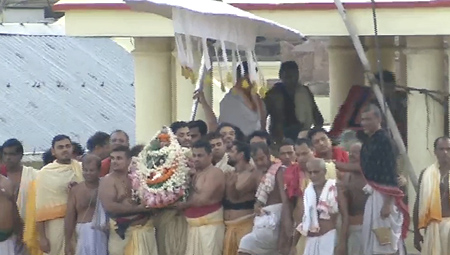
Goddess Mahalaxmi was portraying Her anger, but She was also restless to meet her husband. Her servitors sense her anxiety and carry Her palanquin in a procession from Chahani Mandapa to the king's palace where the Nandighosa chariot is parked. Lord Balabhadra is the elder brother of Lord Jagannath. In Hindu tradition, the elder brother shouldn't see the younger brother's wife's face or shouldn't touch her. If this happens, then it is considered inauspicious. Due to this, when Goddess Laxmi started Her journey from Chahani Mandapa, one parada (screen) is put in front of the Taladhwaja chariot (chariot of Lord Balabhadra) so that He can't see Goddess Mahalaxmi during the procession.
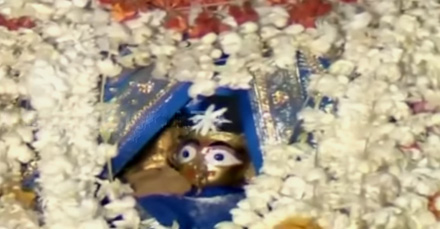
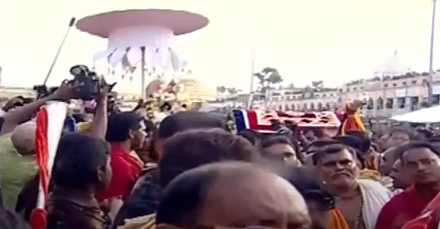
Mahalaxmi is welcomed by the Gajapati Maharaja (King of Puri). Gajapati King escorts Mahalaxi to Nandighosa chariot. The king offers 'Dahipati Manohi' (a special prasad offered on this occasion) to the Goddess and carries the Subarna Laxmi idol on his head and takes Her for a meeting with Lord Jagannath. The Divine couple shares a look and Lord Jagannath presented his 'Agyan Mala' (consent garland) to the Goddess. After receiving the Agyan Mala, Goddess Mahalaxmi takes a circle around the Nandighosa chariot and goes back to the temple with Her servitors and awaits her partner. This celestial meeting between Goddess Laxmi and Lord Jagannath is commonly known as the 'Lakshmi Narayana Bheta'. This divine event clearly shows the human like feelings of the Deities.
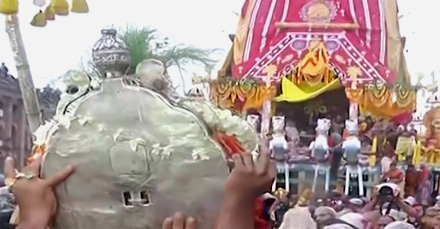
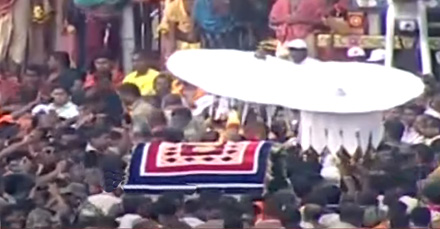
Thereafter the pulling of the Nandighosha chariot from the King’s palace is again resumed by thousands of devotees and concludes at the Lion’s gate of Jagannath temple where the Lord joins His siblings who have already reached there ahead of His arrival. On the day of Bahuda yatra the Deities remain in their respective chariots parked in front of the temple for the Suna Vesha.
| Content Navigation | ||
| Last Page | ||
|
||
| Next Page | ||
|

